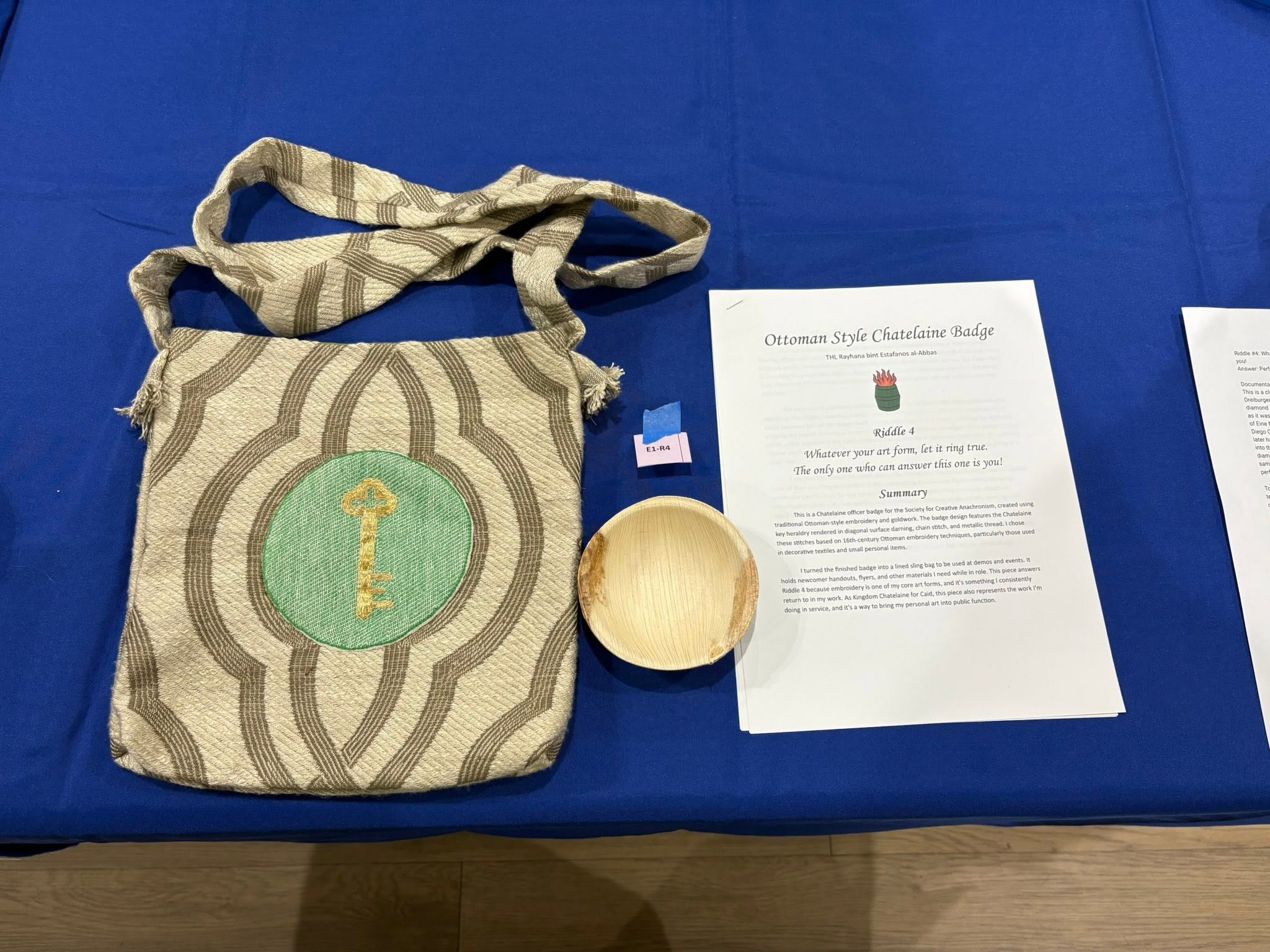
Riddle 4: Whatever your art form, let it ring true. The only one who can answer this one is you!
Summary
This is a Chatelaine officer badge for the Society for Creative Anachronism, created using traditional Ottoman-style embroidery and goldwork. The badge design features the Chatelaine key heraldry rendered in diagonal surface darning, chain stitch, and metallic thread. I chose these stitches based on 16th-century Ottoman embroidery techniques, particularly those used in decorative textiles and small personal items.
I turned the finished badge into a lined sling bag to be used at demos and events. It holds newcomer handouts, flyers, and other materials I need while in role. This piece answers Riddle 4 because embroidery is one of my core art forms, and it’s something I consistently return to in my work. As Kingdom Chatelaine for Caid, this piece also represents the work I’m doing in service, and it’s a way to bring my personal art into public function.
Historical Background & Process
Ottoman embroidery in the 16th century was an important piece of their cultural identity, often used to decorate clothing, accessories, and household textiles. Goldwork was a hallmark of elite embroidery and was typically combined with surface stitches like chain stitch or couching to create bold, elegant designs. For this piece, I referenced examples and motifs from Flowers of Silk and Gold and Ottoman Embroidery to guide both my pattern and stitch selection.
The embroidery combines surface darning on the diagonal with chain stitch and gold couching. The diagonal darning creates a subtle twill-like pattern where the structure of the stitch becomes part of the design itself. It adds both texture and sheen, catching the light and echoing the woven look found in many period textiles. I finished the edges of the badge in chain stitch, which was one of the most commonly used stitches in Ottoman embroidery for outlining shapes and framing motifs. The key itself is outlined in gold floss using a stem stitch, giving it a clean edge.
I stitched the central key motif during the Wintermist Anniversary event, and completed most of the remaining embroidery at the Koroneburg Renaissance Festival while demoing embroidery techniques for the public. This was a great opportunity to engage people in conversation about Ottoman textiles and embroidery traditions while actively working on a piece that had both artistic and functional purpose. Once the embroidery was complete, I turned it into a small crossbody bag that now serves as my regalia for Kingdom Chatelaine. It’s lined and open-topped for ease of use, with enough space to carry newcomer handouts, cards, and other resources. While the shape is modern, the stitching, motifs, and visual feel are all inspired by period examples, and it was made to be an item that will get practical use.
Bibliography
- Ellis, Marianne, and Jennifer Wearden. Ottoman Embroidery. Victoria and Albert Museum, 2001.
- Krody, Sumru Belger. Flowers of Silk and Gold: Four Centuries of Ottoman Embroidery. Merrell, 2000.