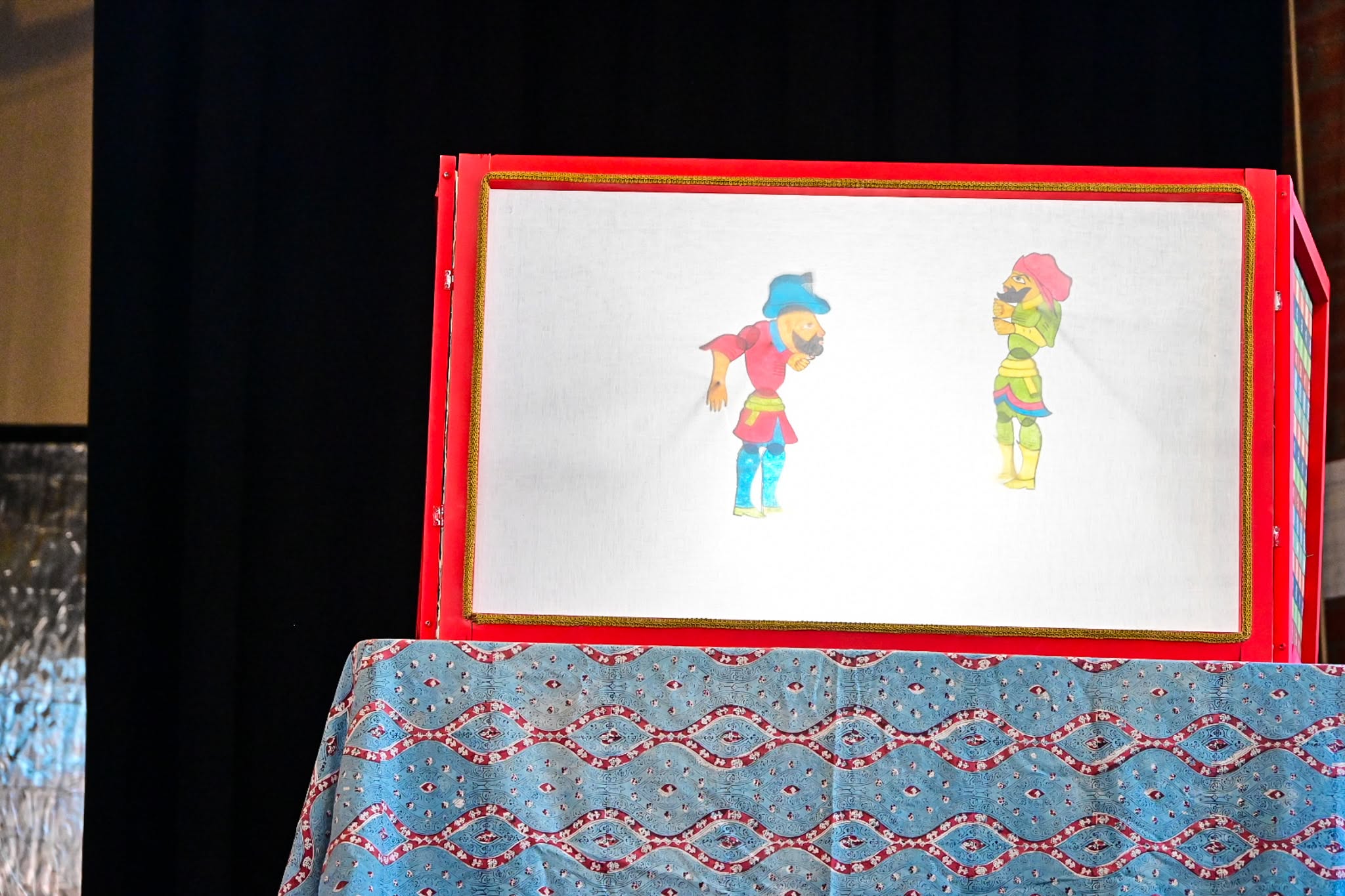
Riddle 2: At the end of a darkened path, you will find me in the light of day. I can be given but never taken away.
Summary
This is a shadow puppet play in the Ottoman Turkish tradition of Karagöz and Hacivat, using hand-painted goat skin puppets, a backlit cloth screen, and a short original script.
Karagöz and Hacivat plays are a traditional form of entertainment in Turkey, with roots going back to at least the 16th century. The shows typically feature stock characters, satirical humor, and a distinctive four-part structure. Performances were usually done during Ramadan or festive gatherings and often included topical and political jokes, slapstick, and wordplay. In my version, Karagöz spends his time at Great Western War volunteering, but it goes poorly.
I consider both the play and the act of performing it to be my answer to Riddle 2. A performance is something that exists only in the moment it’s shared; once it’s given to an audience, it can’t be undone or reclaimed. The riddle also fits the literal form of shadow puppetry: the characters emerge from darkness and appear in light. This project let me explore Ottoman performance traditions while working in a new medium that brings research, storytelling, and humor together.
Process & Historical Context
Karagöz and Hacivat are the lead characters in a style of Ottoman Turkish shadow play that likely dates back to the 16th century. These shows were especially popular during Ramadan and other celebrations, using humor, slapstick, and social commentary to entertain audiences from all walks of life. While the earliest surviving puppets and full scripts don’t appear until later, period sources like the 17th-century traveler Evliya Çelebi describe shadow plays being performed as early as the reign of Sultan Selim I and becoming more widespread under Suleiman the Magnificent. The plays were performed behind a backlit cloth screen using articulated puppets made from translucent animal skin (usually camel or goat), and painted in bright colors to cast vivid shadows.
Each performance followed a recognizable structure: Giriş (introduction), Muhavere (dialogue), Fasıl (main story), and Bitiş (conclusion). The humor came from the back-and-forth between Karagöz, the brash everyman, and Hacivat, his educated and long-winded foil. The stories were usually full of misunderstandings, bad decisions, and lots of physical comedy. The plays often have an edge of satire about society and authority or politics.
For this project, I created a short Karagöz and Hacivat play using the traditional four-part format. The story is set at Great Western War and follows Karagöz as he volunteers across site, with predictably chaotic results. I also added a tambourine, which I used to mark scene changes and emphasize punchlines, serving as a kind of period-appropriate “laugh track”. This addition echoes the use of live sound in traditional performances, where musicians or the puppeteer themselves would punctuate the action. While the content is modern and specific to the SCA, the style, rhythm, and humor are all inspired by historical Ottoman shadow plays.
Bibliography
- And, Metin. Karagöz: Turkish Shadow Theatre. Ankara: Dost Yayınları, 1979.
- UNIMA. “Karagöz.” World Encyclopedia of Puppetry Arts. https://wepa.unima.org/en/karagoz/
- UNESCO. “Karagöz.” Intangible Cultural Heritage Lists. https://ich.unesco.org/en/RL/karagoz-00180
- Daily Sabah. “Karagöz and Hacivat: The iconic duo of Turkish shadow puppetry.” https://www.dailysabah.com/arts/karagoz-and-hacivat