Riddle 1: I can be both soft and hard, delicate and bold. I grow better in time but don’t call me old.
Summary
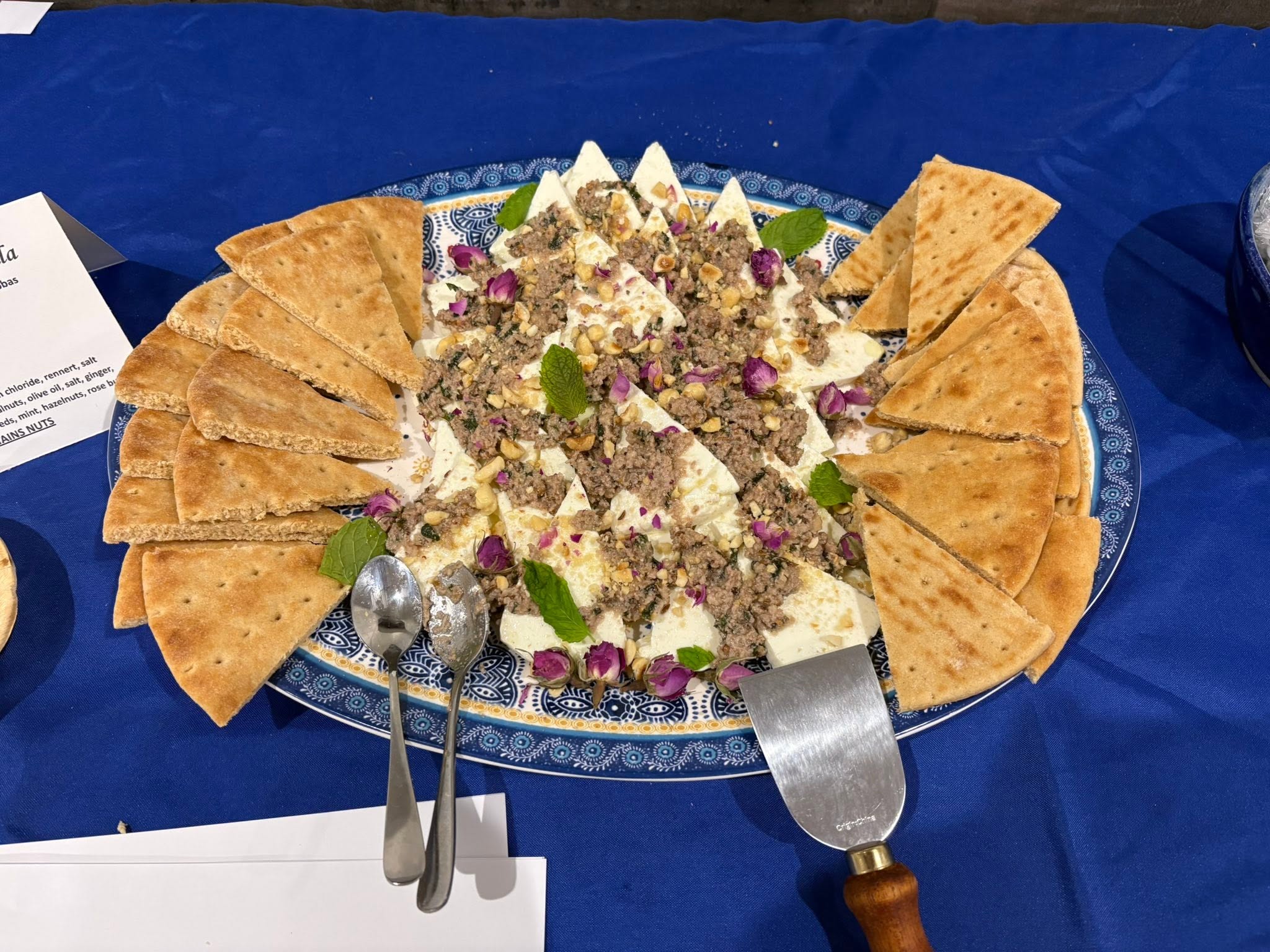
This is a dish of halloumi cheese with a richly flavored relish or topping known as a tatbīla. This dish comes from a 14th-century Arabic cookbook attributed to al-Warrāq. Halloumi cheese is a firm, squeaky cheese that doesn’t melt and modernly is often served grilled. In period, halloum was much the same, but often was brined and aged for some time to preserve it and intensify flavors. The tatbīla adds complexity and depth, highlighting the flavors of the cheese without overpowering it.
Cheese seemed like the obvious choice for answering riddle 1. This riddle led me down a rabbit hole of serious cheese making for the first time. This halloumi is well described by the criteria set out in the riddle: Soft, hard, delicate, bold. It’s been aged for two months, which is a decent amount of time to develop some complex flavors, but certainly not a very old cheese. Cheese is a staple of Ottoman and Arabic cooking, so this was a perfect opportunity to give it a try!
Process & Historical Context
This dish combines a fresh brined cheese (halloum) with a seasoned paste (tatbīla), based on a recipe preserved in a 14th-century Arabic cookbook. While we do not have a surviving period recipe for making halloum itself, the cheese is mentioned by name in several medieval Arabic sources, including Kitāb al-Ṭabīkh by Ibn Sayyār al-Warrāq. This suggests that halloum was a known and commonly used cheese, likely firm, white, and preserved in brine — much like the modern halloumi still eaten across the Levant today. It was probably made from sheep or goat milk and used in both daily meals and more elaborate dishes.
Cheese in medieval Arabic cuisine was often fresh or lightly aged and was frequently seasoned or combined with other ingredients to create more complex flavors. This reflects a broader trend in period cookery, which emphasized contrast and balance; salty with sour, rich with herbal, creamy with crunchy. Seasoned pastes like tatbīla appear throughout Arabic culinary texts and were commonly used to finish meats, vegetables, and preserved foods like cheese.
The tatbīla in this project is adapted from Recipe 522 in “Treasure Trove of Benefits and Variety at the Table”, the modern English translation of Kitāb al-Ṭabīkh by Nawal Nasrallah. It instructs the cook to make a thick paste from garlic, citrus juice, toasted walnuts, and ginger, then stir in coriander, caraway, mint, and rue. The mixture is spread over pieces of halloum cheese, then drizzled with olive oil and garnished with dried rose petals and toasted hazelnuts. I followed the ingredients as closely as possible, but made one key modification: I chose to omit the rue. Although rue was used in period, it is now known to be potentially toxic, especially when fresh, and is not considered safe for general consumption today. I did not substitute another herb, as the existing flavors were already strong and balanced.
Since there is no surviving period recipe for halloum, I used a trusted modern method from Fermenting for Foodies that recreates the likely texture and preservation style of historical brined cheeses; including pressing, poaching in whey, and storing in brine — all steps that produce a firm, salty cheese. I chose this method because it was accessible for a home cheesemaker and allowed me to focus more of my attention on testing and interpreting the tatbīla. I used cow’s milk instead of traditional sheep’s or goat’s milk due to availability.
Halloumi Cheese — Modern Recipe
Full recipe and directions from Fermenting for Foodies
- 2 Gallons whole Cows milk
- ½ tsp calcium chloride
- ½ tsp Rennet
- Salt
To make the cheese, I followed a modern recipe adapted from Fermenting for Foodies. I heated whole milk and added calcium chloride and rennet to set the curd. Once formed, the curd was cut, gently stirred, and heated to help it firm up. The curds were then drained in cheesecloth and pressed to remove excess whey. After pressing, I sliced the cheese into wedges and poached them in the reserved whey which is a key step that gives halloumi its distinctive firm, springy texture. The cheese was then stored in a brine/whey solution and aged in the refrigerator. I made this batch on June 8, 2025, so it has been aging for approximately two months.
Although we don’t have a surviving recipe for making halloumi from the medieval period, it is mentioned by name in several Arabic sources, including Kitāb al-Ṭabīkh by al-Warrāq. This suggests that a firm, brined white cheese was in regular use during the time. The method I used produces a cheese that closely matches the texture and flavor described in historical contexts and allowed me to focus on interpreting the period-accurate seasoned paste (tatbīla) that accompanies it.
Tatbīla (Seasoned Paste)
Original (Translated): Recipe 522 in Treasure Trove of Benefits and Variety at the Table (al-Warrāq, trans. Nasrallah, p. 333-4. 14th c. Egypt)
Recipe for seasoning (tatbīl) hāllūm cheese Take hāllūm cheese, cut it into pieces, and put it in a vessel. Take garlic, skin it, and pound it with a bit of olive oil and salt. Squeeze lime juice (laymūn akhdar) on it, or add wine vinegar. Also add pounded toasted walnuts and ginger. Pound the mix until it has the consistency of ointment (marham). Stir into the mix a small amount of toasted seeds of coriander and caraway, a bit of chopped mint, and a sprig of rue. Season the cheese with it, spread it and drizzle the top with sweet olive oil. Crumble dried rosebuds on it, sprinkle a small amount of coarsely crushed toasted hazelnuts (131v) and eat it. It is delicious.
Redaction:
Tatbila
- 15-20 cloves garlic
- Olive oil
- Salt
- Juice of 2 Limes
- 1⅓ cup toasted walnuts
- 2 tsp dried ginger
- 2 tsp each of coriander seeds, caraway seeds
- ¼ cup fresh chopped mint
Garnish
- Dried rose buds
- Toasted hazelnuts
- Olive oil
Pound the garlic cloves in a mortar until smooth, combining it with a pinch of salt and a small amount of olive oil. Add the juice of 2 limes, the ground ginger, and the walnuts and grind into a paste, adding olive oil as needed for consistency. Mix in the coriander seed, caraway seed, and chopped mint. To serve, spread on halloumi cheese and sprinkle with toasted chopped hazelnuts, dried rose buds, and additional olive oil drizzle.
SAFETY NOTE: Although the original recipe calls for rue, I chose to omit it due to safety concerns. Rue is known today to have toxic properties, particularly when used fresh, and can cause adverse reactions. It’s uncommon in modern cooking for this reason, and potentially unsafe. Its omission does not significantly affect the overall flavor profile of the dish.
Bibliography
- Nasrallah, Nawal. Treasure Trove of Benefits and Variety at the Table: A Fourteenth-Century Egyptian Cookbook. Brill, 2017. (English translation of Kitāb al-Ṭabīkh by Ibn Sayyār al-Warrāq)
- “Halloumi Cheese.” Fermenting for Foodies. https://www.fermentingforfoodies.com/halloumi-cheese/